James Russell invented the compact disk in 1965. James Russell was granted a total of 22 patents for various elements of his compact disk system. However, the compact disk did not become popular until it was mass manufactured by Philips in 1980.
Wednesday, November 25, 2009
Compact Disk or CD
A compact disk (cd) is a popular form of digital storage media used for computer files, pictures, and music. The plastic platter is read and written to by a laser in a CD drive. It comes in several varieties including CD-ROM, CD-R, and CD-RW.

Kalashnikov
Lieutenant General Mikhail Timofeyevich Kalashnikov (Russian: Михаи́л Тимофе́евич Кала́шников, Mihail Timofeevič Kalašnikov) (born November 10, 1919 in Russia's southern Altai region) is a famous Russian small arms designer, most famous for designing the AK-47 assault rifle.
Tuesday, November 24, 2009
Underground coal gasification
Underground coal gasification (UCG) is an industrial process, which enables coal to be converted into product gas. UCG is an in-situ gasification process carried out in non-mined coal seams using injection ofoxidants, and bringing the product gas to surface through production wells drilled from the surface. The product gas could to be used as a chemical feedstock or as fuel for power generation. The technique can be applied to resources that are otherwise not economical to extract and also offers an alternative to conventional coal mining methods for some resources. Compared to the traditional coal mining and gasification, the UCG has less environmental and social impact.
Country’s largest public sector oil exploration company, Oil & Natural Gas Corporation Ltd (ONGC) (BOM: 500312) will operationalize country’s first underground coal gasification (UCG) plant near Surat in Gujarat by October 2010.
Prominent Film Awards in India
Awards
Stard Dust Award
Other awards include the International Indian Film Academy Awards, International Tamil Film Awards, Bollywood Movie Awards, the Nandi Awards and the Global Indian Film Awards.
International Lenin Peace Prize
The International Lenin Peace Prize (Russian: международная Ленинская премия мира) was the Soviet Union's equivalent to the Nobel Peace Prize, named in honor ofVladimir Lenin. It was awarded by a panel appointed by the Soviet government, to notable individuals whom the panel indicated had "strengthened peace among peoples". It was founded as the International Stalin Prize for Strengthening Peace Among Peoples, but was renamed the International Lenin Prize for Strengthening Peace Among Peoples (Russian: Международная Ленинская премия «За укрепление мира между народами») as a result of destalinization. Unlike the Nobel Prize, the Lenin Peace Prize was usually awarded to several people a year rather than to just one individual. The prize was mainly awarded to prominent Communists and supporters of the Soviet Union who were not Soviet citizens.
The prize was created as the International Stalin Prize for Strengthening Peace Among Peoples on December 21, 1949 by the ukaz of the Presidium of the Supreme Soviet in honor of Joseph Stalin's seventieth birthday (although it was actually after his seventy-first). Following Nikita Khrushchev's denunciation of Stalin during the Twentieth Party Congress of 1956, the prize was renamed on September 6 the International Lenin Prize for Strengthening Peace Among Peoples. All previous recipients were asked to return their Stalin Prizes so they could be replaced by the renamed Lenin Prize. By a decision of Presidium of the Supreme Soviet of the USSR of December 11, 1989, the prize was renamed the International Lenin Peace Prize.[1] Two years later, after the USSR had collapsed, the Russian government ended the award program.
The International Lenin Prize should not be confused with the International Peace Prize, awarded by the World Peace Council. There was also a Stalin Prize (later renamed theUSSR State Prize) created during 1941 which was awarded annually to accomplished Soviet writers, composers, artists and scientists.
Wall Street
Wall Street is a street in Lower Manhattan, New York City, New York, United States. It runs east from Broadway to South Street on the East River, through the historical center of the Financial District. It is the first permanent home of the New York Stock Exchange; over time Wall Street became the name of the surrounding geographic neighborhood. Wall Street is also shorthand (or a metonym) for the "influential financial interests" of the American financial industry, which is centered in the New York City area.[2]
Several major U.S. stock and other exchanges remain headquartered on Wall Street and in the Financial District, including the NYSE, NASDAQ, AMEX,NYMEX, and NYBOT.
Chinese watch
Shenzhou 7 (simplified Chinese: 神舟七号; traditional Chinese: 神舟七號; pinyin: shénzhōu qīhào) was the third human spaceflight mission of the Chinese space program. The mission, which included the first Chinese extra-vehicular activity (EVA) carried out by crewmembers Zhai Zhigang and Liu Boming, marked the commencement of the second phase of the Chinese government's Project 921.
The Shenzhou spacecraft carrying the three crewmembers was launched 25 September 2008, by a Long March 2F (CZ-2F) rocket which lifted off from the Jiuquan Satellite Launch Center at 21:10 CST.[1][3] The mission lasted three days, after which the craft landed safely in Siziwang Banner in central Inner Mongolia on 28 September 2008, at 17:37 CST. The EVA carried out during the flight makes China the third country to have conducted an EVA, after the Soviet Union and the United States.
Monday, November 23, 2009
Hatch Act of 1939
The Hatch Act of 1939 is a United States federal law whose main provision is to prohibit federal employees (civil servants) from engaging in partisan political activity. Named after Senator Carl Hatch of New Mexico, the law was officially known as An Act to Prevent Pernicious Political Activities.
The act precluded federal employees from membership in "any political organization which advocates the overthrow of our constitutional form of government." During the Second Red Scare, this designation was interpreted to include communist and labor organizations.
jungles of Goa
Foxes, wild boars and migratory birds are found in the jungles of Goa. The avifauna includes kingfishers, mynas and parrots. Numerous types of fish are also caught off the coast of Goa and in its rivers. Crabs, lobsters, shrimps, jellyfish, oysters and catfish form some of the piscine catch. Goa also has a high snake population, which keeps the rodentpopulation in control. Goa has many famous National Parks, including the renowned Salim Ali bird sanctuary. Other wildlife sanctuaries include the Bondla Wildlife Sanctuary,Molem Wildlife Sanctuary, Cotigao Wildlife Sanctuary, Madei Wildlife Sanctuary, Netravali Wildlife Sanctuary Mahaveer Wildlife Sanctuary and the Salim Ali Bird Sanctuary located on the island of Chorao.
Sariska
Sariska is probably one of the most visited parks in India. Unfortunately though, the main reason for this is not wildlife enthusiasm but only it's excellent proximity to some large towns like Delhi and Jaipur. The park was, as with many other parks, the hunting reserve of the royal family in the area. In this case, it was the Royal family of Alwar Rajasthan . The reserve was declared a wildlife sanctuary in 1958 and came under the "Project Tiger" as a Sariska tiger reserve in 1979. The park covers quite a large area of 800 square kilometers, 480 square kilometers of which form the core area of the national park. It is located among the Aravalli hill ranges in the Alwar district of Rajasthan. Due to the presence of monuments of religious importance located within the park boundaries, the park authorities are compelled to keep the park open throughout the year. The summer months are better for animal viewing but are extremely hot with temperatures going up to as high as 49 degrees centigrade. In the winter months, the temperature touches a low of 4 degrees.
Lowest Point on Earth
The lowest point on land is the Dead Sea that borders Israel, the West Bank and Jordan. It's 420 meters below sea level.
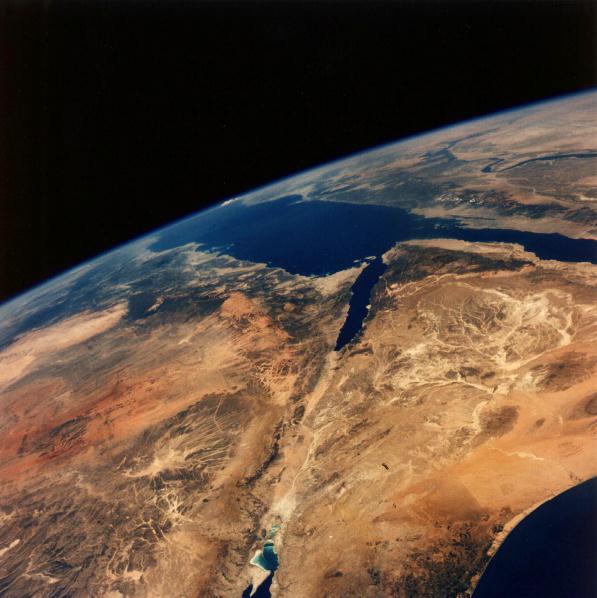
The Dead Sea sits on top of the Dead Sea Rift, a tectonic fault line between the Arabian and the African plates. The movement of these plates causes the Dead Sea to sink about one meter per year! The Dead Sea used to be connected to the Mediterranean Ocean, but over a geologic time scale, it became cut off and evaporation concentrated the salt in the water so that today, the Dead Sea is 30 to 31 percent mineral salts. It has the highest level of salinity of any body of water in the world.
The lowest point on land in the Western Hemisphere is Death Valley in California at 86 meters below sea level.
The lowest point on the Earth's crust is the Mariana's Trench in the North Pacific Ocean. It is 11 kilometers deep. Like many of Earth's extremes, the Mariana's Trench is caused by the Pacific tectonic plate subducting beneath the Philippine plate; this means that the Pacific Plate is sliding underneath the Philippine plate. The point where the Philippine plate overlaps is Mariana's Trench.
Programmer
A programmer is someone who writes computer software. The term computer programmer can refer to a specialist in one area of computer programming or to a generalist who writes code for many kinds of software. One who practices or professes a formal approach to programming may also be known as a programmer analyst. A programmer's primary computer language (Lisp, Java, Delphi, C++, etc.) is often prefixed to the above titles, and those who work in a web environment often prefix their titles with web. The term programmer can be used to refer to a software developer, software engineer, computer scientist, or software analyst. However, members of these professions typically possess other software engineering skills, beyond programming; for this reason, the term programmer is sometimes considered an insulting or derogatory oversimplification of these other professions. This has sparked much debate amongst developers, analysts, computer scientists, programmers, and outsiders who continue to be puzzled at the subtle differences in these occupations
Sistine Chapel ceiling
The Sistine Chapel ceiling, painted by Michelangelo between 1508 and 1512, at the commission of Pope Julius II, is one of the most renowned artworks of the High Renaissance. The ceiling is that of the large Papal Chapel built within the Vatican between 1477 and 1480 by Pope Sixtus IV after whom it is named the Sistine Chapel. The chapel is the location for Papal Conclaves and many important services.
Calorific value of fuels
Calorific value of fuels
Heat energy is measured in units of joules or calories (1calorie = 4.18 joules). The heat generated by fuels when they burn in joules or calories measures quality of fuels. All fuels do not burn efficiently. Thus there are fuels that produce more heat than the others are. This can be distinguished in terms of number of joules or calories that they generate on burning.
The amount of energy generated when 1 unit mass of fuel is burnt completely is known as the calorific value of the fuel. The word calorific is used, not “joulific” because of the use of the word calorific has been in use for a very long time. When 1 gram of charcoal is burnt, it produces 33 kilo joules. Thus the calorific value of charcoal is 33kJ/g. Sometimes instead of calorific value, another term kilowatt per kilogram (KWh/kg) is used.
hydrogens calorific value is 150
Scientists identify coldest place on earth
Scientists have identified what they believe to be the coldest place on earth.
The site, known simply as Ridge A, is nearly 14,000 metres high and is located deep within the Antarctic Plateau.
It has an average winter temperature of minus 94 degrees Fahrenheit (minus 70 degrees Celsius) and is so remote that it is thought that no human has ever set foot there.
IAF lost 36 aircraft, 32 lives in plane crashes since 2006
New Delhi: The IAF has lost 36 aircraft and seven helicopters in accidents during a period of nearly four years beginning 2006 as 32 persons, including IAF personnel, were killed in the mishaps, the Lok Sabha was told today.
KING OF FAUVES
 The Goldfish, 1912
o/c, 146x97 cm
Matisse
Matisse
Since the proto-colorists were called "Fauvists," it has been my long time goal to study that most-noted Fauve, Henri Matisse (1800-1950). Matisse persisted in his ultra colorful style even after the era of the short-lived Fauvist movement (1905-7), which featured stylized realism and assigned non-local color to objects.
The giant Pablo Picasso overshadowed Matisse as they both worked simultaneously to create Modern Art in the early part of the Twentieth Century. Picasso, the great Cubist, and Matisse, the father of Fauvism, were friendly rivals. The one brought us the line, the other brought us color in the Modern Art sense.
David Crockett
David Crockett (August 17, 1786 – March 6, 1836) was a celebrated 19th-century American folk hero, frontiersman, soldier and politician; referred to in popular culture as Davy Crockett and often by the epithet “King of the Wild Frontier.” He represented Tennessee in the U.S. House of Representatives, served in the Texas Revolution, and died at the Battle of the Alamo.
Subscribe to:
Posts (Atom)
